Categories
Retirement & Tax Planning

QCDs vs. Donor-Advised Funds: Which Is the Smarter Way to Give in 2026?

By Katy McDonald, Baker Ellis · November 2026

Two of the most effective tools for charitable giving today work in very different ways. A qualified charitable distribution (QCD) sends money straight from your IRA to a charity. A donor-advised fund (DAF) lets you take a deduction now and choose where the money goes later. The 2026 tax changes widened the gap between them, and choosing the right one can be worth thousands of dollars a year.

First, the quick facts:

Qualified charitable distributions

  • Who can use them: IRA owners 70½ or older. 401(k)s don’t qualify, so those dollars must be rolled into an IRA first.
  • How much: up to $111,000 per person in 2026. A one-time QCD of up to $55,000 can also fund a charitable gift annuity or charitable remainder trust.
  • The tax benefit: the gift never shows up in your income, and it counts toward your required minimum distribution.
  • Where it can go: directly to a public 501(c)(3) charity. Donor-advised funds, private foundations, supporting organizations and political groups can’t receive QCDs.

Donor-advised funds

  • Who can use them: anyone, at any age.
  • What you can give: cash, or investments you’ve held for more than a year, such as appreciated stock. We usually recommend giving appreciated stock rather than cash (more on why below).
  • The tax benefit: you get your deduction in the year you fund the DAF (if you itemize). If you give appreciated stock, you never pay capital gains tax on its growth, because you’re gifting the shares rather than selling them and giving the cash. Inside the DAF, the money can keep growing until you recommend a grant to the charity of your choice. That grant has no tax impact for you, good or bad, since you already received your deduction when you funded the account.
  • The limits: deductions are capped at 60% of your income for cash and 30% for appreciated stock, with any excess carried forward for up to five years. Gifts are irrevocable, and DAF grants can’t be used to fulfill a personal pledge or pay for event tickets or anything else that benefits you.
  • The cost: Fidelity Charitable Gift Fund, where many of our clients maintain donor-advised funds, has no minimum to open an account, a $50 minimum grant and an annual administrative fee of 0.60% or $100, whichever is greater, plus any investment fees (we waive our advisory fee on gift fund accounts, but you might have fees for owning a mutual fund or other investment in the account). It also requires you to recommend at least one grant every two years.

What changed in 2026:

  • A new floor for itemizers. Only gifts above 0.5% of your adjusted gross income are deductible if you itemize. With $300,000 of income, the first $1,500 you give earns no deduction. (This applies to charitable gifts in general, not just gifts to a donor-advised fund.)
  • A new cap for top earners. For those in the 37% bracket, the deduction is now worth at most 35 cents per dollar.
  • A new deduction for everyone else. If you take the standard deduction, you can now deduct up to $1,000 ($2,000 for married couples) of cash gifts to public charities. Gifts to donor-advised funds don’t count.
  • QCDs weren’t touched. Because a QCD is excluded from income rather than deducted, neither the floor nor the cap applies.

Our take in brief:

  • If you’re 70½ or older and give from an IRA, start with a QCD. Most retirees now take the standard deduction, which means a check from the bank to a charity saves nothing in taxes. A QCD still does, at every income level.
  • A QCD beats a deduction, dollar for dollar. Every dollar you give through a QCD comes straight off your income, whether or not you itemize, and it also lowers the income that sets your Medicare premiums and Social Security taxes. A dollar given to a DAF only cuts your taxes if you itemize, only the portion above the new 0.5% floor counts, and for top earners each dollar is worth at most 35 cents.
  • A DAF shines in a big year. If you’re under 70½, have stock with large gains or have an unusually high-income year from a business sale, a bonus or a large Roth conversion, a DAF lets you capture the deduction when it’s worth the most.
  • Many of our clients use both. QCDs handle annual giving from the IRA, and a DAF holds appreciated stock to be granted out over time.

Three examples:

  • Margaret, 75, gives $10,000 a year and takes the standard deduction. Writing checks gets her no tax benefit. Sending the same $10,000 as a QCD lowers her taxable RMD from about $20,325 to $10,325, saving about $2,200 in federal tax at a 22% rate.
  • David and Susan, 62, sold their business this year and have $900,000 of income. Instead of writing checks, they give $100,000 of stock they bought for $20,000 to a DAF. They never pay capital gains tax on the $80,000 of growth, which saves about $19,000, and they get a deduction worth roughly $33,000 after the new floor and cap. They can recommend grants from the DAF for years to come.
  • Jim and Carol, 66, give $15,000 a year. Their itemized deductions fall short of the standard deduction, so their giving earns no tax benefit. By putting three years of giving ($45,000) into a DAF in one year, they itemize that year and take the standard deduction in the other two, while their charities still receive grants every year.

A few practical notes:

  • QCDs take a little paperwork. Brittany can set you up with an IRA checkbook so you can write QCD checks yourself, or she can send you a DocuSign to issue the check on your behalf.
  • If using a portion of your RMD, process the QCD first. Money already withdrawn to you can’t be turned into a QCD later, so we schedule QCDs before the rest of your RMD.
  • Give stock, not cash, to a DAF. Contributing investments with large gains avoids the capital gains tax entirely. Say you own stock you bought for $20,000 that’s now worth $100,000. Sell it and give the cash, and you owe tax on the $80,000 gain first. Give the shares instead, and the charity receives the full $100,000, you never pay the capital gains tax and, if you itemize, you deduct the full market value. Stock transfers take longer than cash, so start well before year-end.
  • A QCD can’t go into a DAF. If you’re 70½ or older and want both benefits, use QCDs for IRA dollars and give appreciated stock from a taxable account to the DAF.

Thinking about your giving for this year? Give us a call. We’re here and happy to help you decide which approach fits, how much to give and how it works alongside your RMDs and any Roth conversion.

This article is for general informational and educational purposes only. Nothing on it is investment, tax, legal, or accounting advice, and nothing on it recommends or offers to buy or sell any security. Tax and planning topics are general and may not apply to your situation. Tax laws also change often. Please consult a qualified tax or legal professional before acting on any information here. The information is believed to be reliable as of the date of publication. Baker Ellis Asset Management LLC does not guarantee its accuracy, and it may not be updated. Reading this blog does not create an advisory relationship.


Categories
Retirement & Tax Planning

2026 Year-End Tax Checklist: 7 Moves Retirees Should Make Before December 31

By Katy McDonald, Baker Ellis · November 2026

Most of the tax moves that matter in retirement share one deadline: December 31. Miss it, and the opportunity is gone for the year. Year-end planning is genuinely one of my favorite parts of this job, because it’s where a handful of small decisions add up to real money for our clients.

This year deserves extra attention. 2026 is the first year several changes from the One Big Beautiful Bill Act apply at once: a new $6,000 deduction for people 65 and older, a new floor on charitable deductions and new IRS reporting for charitable gifts from IRAs. Today’s lower tax rates also no longer have a scheduled expiration date, so we can plan further ahead with more confidence.

Our take in brief:

  • Order matters. When it comes to satisfying your required minimum distribution (RMD), the sequence makes a difference.
    1. First, start with any charitable gifts from your IRA (more on this below)
    2. Next, distribute your remaining RMD
    3. Lastly, complete a Roth conversion if this strategy makes sense for your plan.
  • Charitable giving changed the most. Most retirees now take the standard deduction, so cash to a charity earns little tax benefit beyond the new $1,000 deduction ($2,000 for couples). Writing a check to the charity straight from your IRA (if 70 ½ or older) comes off your income dollar for dollar, whether or not you itemize.
  • Watch the cliffs. Going even $1 over a Medicare income threshold can raise your premiums for a full year, so we size every move with those lines in mind.

Here are the seven moves we walk every client through:

1. Take your required minimum distribution:

Pre-tax 401(k)s and IRAs come with two big perks: a tax deduction when you contribute, and tax-deferred growth while the money is invested. The catch is that those taxes are deferred, not forgiven. Once you reach a certain age, the IRS requires you to start withdrawing, and each year’s required minimum distribution (RMD) must come out by December 31.

  • When they start. Age 73 if you were born 1951 through 1959, and age 75 if you were born in 1960 or later.
  • Still working? You can usually wait to take RMDs from your current employer’s 401(k) until you retire, as long as you don’t own 5% or more of the company. IRAs don’t get this break.
  • How it’s calculated. Divide your balance on December 31 of last year by an IRS “distribution period” based on your age. Margaret turns 75 in 2026, and her IRA was worth $500,000 at the end of 2025. Her distribution period is 24.6, so her 2026 RMD is about $20,325.
  • It grows every year. The required share is about 3.8% of your balance at 73, 4.1% at 75, 5.0% at 80, 6.3% at 85 and 8.2% at 90. If your spouse is more than 10 years younger and is your sole beneficiary, a different table gives you a smaller RMD.
  • Your first RMD. You can wait until April 1 of the following year, but then you’ll take two RMDs in one tax year, which can push you into a higher bracket.
  • Inherited an IRA? Many beneficiaries now must take withdrawals every year under the 10-year rule. If you’re not sure whether that applies to you, just ask.
  • Missed one? The penalty is 25% of the amount you should have taken, reduced to 10% if you fix it quickly. Call us right away and we’ll help you correct it.
  • More than one account? RMDs from multiple IRAs can be added up and taken from any one of them. Each 401(k), however, must pay out its own RMD.

Simplifying is part of the plan. With every client, we look at whether consolidating accounts makes sense (and we assist with this process). Fewer accounts means fewer RMDs to track and a much simpler year-end.

2. Give from your IRA with a qualified charitable distribution (QCD):

If you’re 70½ or older and give to charity, a QCD is often the single most tax-efficient way to do it. The money goes straight from your IRA to the charity and never shows up in your taxable income.

  • Up to $111,000 per person in 2026. Married couples can each give up to that amount from their own IRAs.
  • It counts toward your RMD. Every dollar you give through a QCD is a dollar you don’t have to withdraw and pay tax on.
  • It sidesteps the new charitable deduction rules. A QCD isn’t a deduction, so the new 0.5% floor doesn’t touch it. Keeping your income lower also helps protect income-based benefits like the senior deduction and your Medicare premiums.
  • Order matters. Make your QCD before you finish taking your RMD. Money already withdrawn to you can’t be turned into a QCD later.
  • Not every charity qualifies. Donor-advised funds and private foundations can’t receive QCDs, but most other public charities can.
  • New this year. QCDs now get their own code on Form 1099-R. Still give your tax preparer a heads-up and keep the charity’s receipt.

Ready to give? Call Brittany on our team. She’ll make sure your QCD is processed in time to reach the charity before your custodian’s year-end cut-off. If you’re still choosing where to give, Willamette Week’s Give!Guide is a great place to discover local nonprofits. We cover how QCDs compare with donor-advised funds in a separate post.

3. Fill your tax bracket with a Roth conversion:

A Roth conversion moves money from a traditional IRA into a Roth IRA. You pay income tax on the amount now, and in exchange the money grows and comes out tax-free later. Roth IRAs also have no RMDs and can be one of the best assets to leave to your heirs.

The sweet spot is a lower-income year, often the window between retirement and when RMDs or Social Security begin. In 2026, a married couple’s 12% bracket runs up to $100,800 of taxable income, and the 22% bracket runs up to $211,400. Converting just enough to fill a lower bracket you’d otherwise leave unused is one of the most valuable moves in retirement planning.

Before we recommend a conversion, we always check three tripwires:

  1. Medicare premiums. Medicare looks back two years, so your 2026 income sets your 2028 Part B and D premiums. The surcharges (known as IRMAA) currently start above $109,000 of income for single filers and $218,000 for married couples.
  2. The new senior deduction. If you’re 65 or older, you can deduct an extra $6,000 from 2025 through 2028. It shrinks once income passes $75,000 ($150,000 for couples), so a large conversion can quietly erase it.
  3. Taxes on Social Security. More income can make more of your Social Security benefit taxable.

Conversions must be completed by December 31 and can’t be undone. We’ll also help you decide where the tax money should come from: savings, a taxable account or the IRA itself. We dig into conversions in more detail in a separate post.

4. Review gains and losses in taxable accounts:

If you have a taxable account (a regular brokerage account outside your IRAs and 401(k)s), year-end is the time to look at both sides of the ledger.

  • Harvest losses. Selling investments worth less than you paid can offset gains you’ve realized this year, plus up to $3,000 of ordinary income. Watch the wash-sale rule: buying back the same or a substantially identical investment within 30 days cancels the benefit.
  • Harvest gains. In 2026, married couples with taxable income up to $98,900 ($49,450 for single filers) pay 0% federal tax on long-term gains. If you’re under that line, you may be able to sell winners, owe nothing and buy them back at a higher cost basis.

5. Rethink charitable giving under the new rules:

  • If you itemize: starting this year, only gifts above 0.5% of your adjusted gross income are deductible. With $200,000 of income, the first $1,000 you give earns no deduction. For those in the top 37% bracket, the benefit is also capped at 35 cents per dollar. “Bunching” two or three years of gifts into one year, often through a donor-advised fund, can help more of your giving count.
  • If you take the standard deduction: you can now deduct up to $1,000 ($2,000 for married couples) of cash gifts to public charities, even without itemizing. Gifts to donor-advised funds don’t qualify.
  • If you’re 70½ or older: start with the QCD in move #2. For most retirees, it’s the best option of all.

6. Use your annual gift exclusion:

You can give up to $19,000 per person in 2026 ($38,000 for married couples giving together) without filing a gift tax return or using any of your lifetime exemption. Whether it’s help with a down payment or simply a holiday gift, it must be completed by December 31 to count for this year.

One more tip: if you’d like to help with tuition or medical bills, pay the school or provider directly. Those payments don’t count toward the $19,000 limit at all. (For school, this covers tuition only, not room, board or books.)

7. Final checks before the year ends:

☐ Confirm your fourth-quarter estimated tax payment (due January 15, 2027)

☐ Review the beneficiaries on your IRAs, 401(k)s and life insurance

☐ For accounts we don’t manage, ask the custodian about year-end cut-off dates. Many stop processing QCDs and conversions in mid-December.

Let’s get your year-end plan in place:

Each of these moves affects the others. A Roth conversion can raise your Medicare premiums; a QCD can make room for a larger conversion. The right mix depends on your income, your giving goals and the legacy you want to leave, and we model it over several years, not just this one.

Give us a call before mid-December. I’m happy to sit down with you at our office or your home, walk through the numbers and leave plenty of time to get everything done before the deadlines.

This article is for general informational and educational purposes only. Nothing on it is investment, tax, legal, or accounting advice, and nothing on it recommends or offers to buy or sell any security. Tax and planning topics are general and may not apply to your situation. Tax laws also change often. Please consult a qualified tax or legal professional before acting on any information here. The information is believed to be reliable as of the date of publication. Baker Ellis Asset Management LLC does not guarantee its accuracy, and it may not be updated. Reading this blog does not create an advisory relationship.

Categories
Retirement & Tax Planning

Roth Conversions in 2026: Who Should Convert, How Much and Why Timing Matters

By Katy McDonald, Baker Ellis · November 2026

A Roth conversion is a simple trade: pay tax on retirement savings now so the money can grow and come out tax-free later. Whether that trade is worth it depends on more than just guessing where tax rates are headed. A comprehensive analysis requires looking at your own current versus future tax brackets, how a conversion could affect things like Medicare premiums or Social Security taxes, and whether the heirs of your retirement account would benefit from the different rules for minimum required distributions from a Roth. The answers are different for every family, and that’s where we come in. We run the numbers with you, weigh the trade-offs and help you decide how much, if any, to convert each year.

First, the quick facts:

  • What is it. You move money from a traditional IRA (or a prior 401(k)) into a Roth IRA. The amount you convert is taxed as ordinary income this year.
  • No income limit. Anyone can convert, at any income level.
  • No take-backs. Since 2018, a conversion can’t be reversed, so we size it carefully before it happens.
  • One deadline. A conversion must be completed by Dec. 31 to count for 2026. Many custodians stop processing conversions in mid-December, and each one takes time to complete, so a call on Dec. 31 is cutting it too close. We aim to wrap up year-end strategies by the first week of December, which is why most of our year-end conversations begin in October.
  • No required distributions. Roth IRAs have no RMDs during your lifetime, and heirs generally inherit the money tax-free (though most must still empty the account within 10 years). One catch for those already taking RMDs: a conversion doesn’t count toward your required distribution. You must take that year’s RMD first, and the RMD itself can’t be converted.
  • A five-year clock. Each conversion starts its own five-year clock. If you’re under 59½, withdrawing converted dollars before then can trigger a 10% penalty.

Our take in brief:

  • Today’s rates are known; tomorrow’s aren’t. The 2025 tax law extended today’s individual tax rates with no scheduled expiration date, but Congress can always change them. Paying tax at a rate you know can be worth more than hoping for a lower one later, especially with the country running massive deficits.
  • The best window is often the “gap years.” The years between retirement and when RMDs or Social Security begin are often the lowest-income years of a person’s life, and the best time to convert. That doesn’t rule out converting once RMDs or Social Security begin. It just takes more careful planning, and in some years, it may not make sense.
  • Washington residents have a deadline worth noting. Washington’s new 9.9% tax on income above $1 million takes effect January 1, 2028. For very large conversions, 2026 and 2027 are the last years without a state tax bill. Oregon residents, by contrast, pay up to 9.9% in state tax on every dollar converted.
  • It isn’t for everyone. If you expect to be in a lower bracket later, plan to leave your IRA to charity or would have to pay the tax out of the IRA itself; converting may not make sense.
  • The end of recharacterization raises timing risk: prior to 2018, the IRS allowed you to recharacterize, or undo, a conversion by October of the next year. That way, you could reverse the conversion if the market dropped, so you didn’t have to pay tax on a larger “phantom” value. The Tax Cuts and Jobs Act of 2017 eliminated recharacterizations for conversions. That means if the market falls by 50% after you convert, you are stuck with the tax bill on the value at the time of conversion – a risk worth considering when markets are trading at or near historic highs.

How much to convert? Fill the bracket:

There’s no one-size-fits-all amount. For many clients, we convert just enough each year to “fill up” a lower tax bracket they’d otherwise leave unused. For others, it makes sense to front-load conversions into a few years, such as before RMDs or Social Security begin, or ahead of Washington’s new income tax in 2028. It all depends on your situation.

In 2026:

  • Married couples: the 12% bracket runs up to $100,800 of taxable income, the 22% bracket to $211,400 and the 24% bracket to $403,550.
  • Single filers: the 12% bracket runs up to $50,400, the 22% bracket to $105,700 and the 24% bracket to $201,775.

Here’s an example. Tom and Linda, both 67, are retired and waiting to claim Social Security. Their 2026 taxable income is $60,000. Converting $40,800 fills the rest of their 12% bracket for about $4,896 in federal tax. Every dollar after that would be taxed at 22%, so whether to keep going depends on what they expect their bracket to be once RMDs and Social Security start.

Three tripwires we always check:

  1. Medicare premiums. Medicare looks back two years, so your 2026 income sets your 2028 Part B and D premiums. The surcharges (known as IRMAA) currently start above $109,000 of income for single filers and $218,000 for married couples; crossing a threshold by even $1 raises premiums for the whole year. Filling the 22% bracket can push a couple past that first line, so we often stop just short.
  2. The new senior deduction. People 65 and older can deduct an extra $6,000 each from 2025 through 2028. It shrinks by 6% of income above $75,000 ($150,000 for couples) and disappears entirely at $175,000 ($250,000 for couples). A conversion in that range costs you the tax on the conversion plus part of the deduction.
  3. Taxes on Social Security. If you’re already collecting benefits, more income can make up to 85% of them taxable.

If you retire before age 65 and buy health insurance on the marketplace, a conversion can also reduce your premium subsidies. The enhanced subsidies expired after 2025, so the income limits matter more than they did previously.

Paying the tax:

The most efficient way to pay is with cash from savings or a taxable account, so the full converted amount keeps growing tax-free. Paying the tax out of the IRA itself shrinks the conversion, and if you’re under 59½, the amount withheld can also be hit with a 10% penalty. Selling investments to raise the cash is another chance to harvest tax losses where appropriate.

How we approach it:

We never look at a conversion in isolation. We model it over several years alongside your RMDs, Social Security timing, charitable giving and estate plan. A qualified charitable distribution, for example, can lower your income enough to make room for a larger conversion in the same year.

Give us a call this month. Custodians set their own year-end cut-offs, and conversions take time to process. If you are interested in exploring a Roth conversion, we’re here and happy to run the numbers with you while there’s still time to act this year.

This article is for general informational and educational purposes only. Nothing on it is investment, tax, legal, or accounting advice. Tax and planning topics are general and may not apply to your situation. Tax laws also change often. Please consult a qualified tax professional before acting on any information here. The information is believed to be reliable as of the date of publication. Baker Ellis Asset Management LLC does not guarantee its accuracy, and it may not be updated. Reading this blog does not create an advisory relationship

Categories
Fraud & Security

AI-Powered Scams Are Here: How to Protect Yourself and Your Accounts

By Katy McDonald, Baker Ellis · November 2026

AI can now draft an email, summarize a report or plan a trip in seconds. It can also clone the voice of someone you love from a few seconds of video posted online. The FBI’s latest numbers show how quickly scammers have put it to work.

First, the numbers:

  • AI is now its own category. In 2025, the FBI’s Internet Crime Complaint Center received more than 22,000 complaints involving AI, with reported losses of about $893 million. It was the first year the report tracked AI separately.
  • Older Americans are the biggest target. People 60 and older filed 201,266 complaints and reported $7.7 billion in losses, up 59% in a single year. That works out to more than $38,000 per victim.
  • Investment and “tech support” scams lead. Investment fraud accounted for $3.5 billion of those losses, and fake tech support scams for another $1 billion.

And those are only the cases people reported.

Our take in brief:

The technology is new, but the playbook isn’t. Nearly every scam still combines three things: urgency (“right now”), secrecy (“don’t tell anyone”) and a request for money or information. The best defenses are refreshingly low-tech, and a close relationship with your advisor is one of the strongest protections there is. We know your voice, your habits and your plans, and we notice when something doesn’t fit.

How AI is changing familiar scams:

  • The voice clone. A few seconds of audio from a social media video can be enough to mimic someone’s voice. The call goes something like: “Grandma, I’m in trouble. Please don’t tell Mom. I need money right now.”
  • The deepfake video. Scammers can appear on screen as someone you trust, from a celebrity promoting a can’t-miss investment to a “bank official” walking you through how to “protect” your account.
  • The flawless phishing email. Spelling mistakes used to be a giveaway. AI has largely eliminated them, and today’s fake emails from your “custodian” can look exactly like the real thing.
  • The fake support rep. A call or text warns of fraud on your account and urges you to move money to a “safe” account or read back a code they just sent you.

A real example from our office:

Not long ago, a client emailed asking us to send money to a different bank account for a gift for his wife. The request came as a reply to an email I had sent him, and he’d made a similar request before for a surprise birthday trip, so everything about it looked normal. We called him anyway. His email had been hacked, and he never sent that message.

That call is a firm rule, not a judgment call.

  • We will always call you to confirm any request to move money that arrives by email, report suspicious activity to your custodian right away and work with them to lock down your account.
  • We will never ask for your password or a verification code, pressure you to move money in a hurry or change where your money is sent based on an email alone.
  • If something feels off, you can call anyone on our team.

Simple defenses that work:

  1. Pick a family safe word. Choose something memorable but random that has never been posted online. If an “emergency” call comes in, ask for it. A cloned voice can’t know a secret it never heard.
  2. Hang up and call back. Use a number you already have, not the one that just called you. Caller ID can be faked.
  3. Guard your verification codes. Firms often text a code to confirm it’s really you, and that’s normal. Only share a code when you started the contact, by logging in yourself or calling a number you know is real. If someone reaches out of the blue and asks you to read back a code, hang up.
  4. Slow down. A real emergency can survive the five minutes it takes to verify. Scammers count on you not taking them.
  5. Lock the doors. Use two-factor authentication (an authenticator app is best), a unique password for every financial account and alerts for logins and withdrawals. A free credit freeze at all three credit bureaus adds another lock.
  6. Think before you post. Consider making social media accounts private, especially videos where your voice or your family’s voices are easy to grab.

If something does slip through, here’s what protects you:

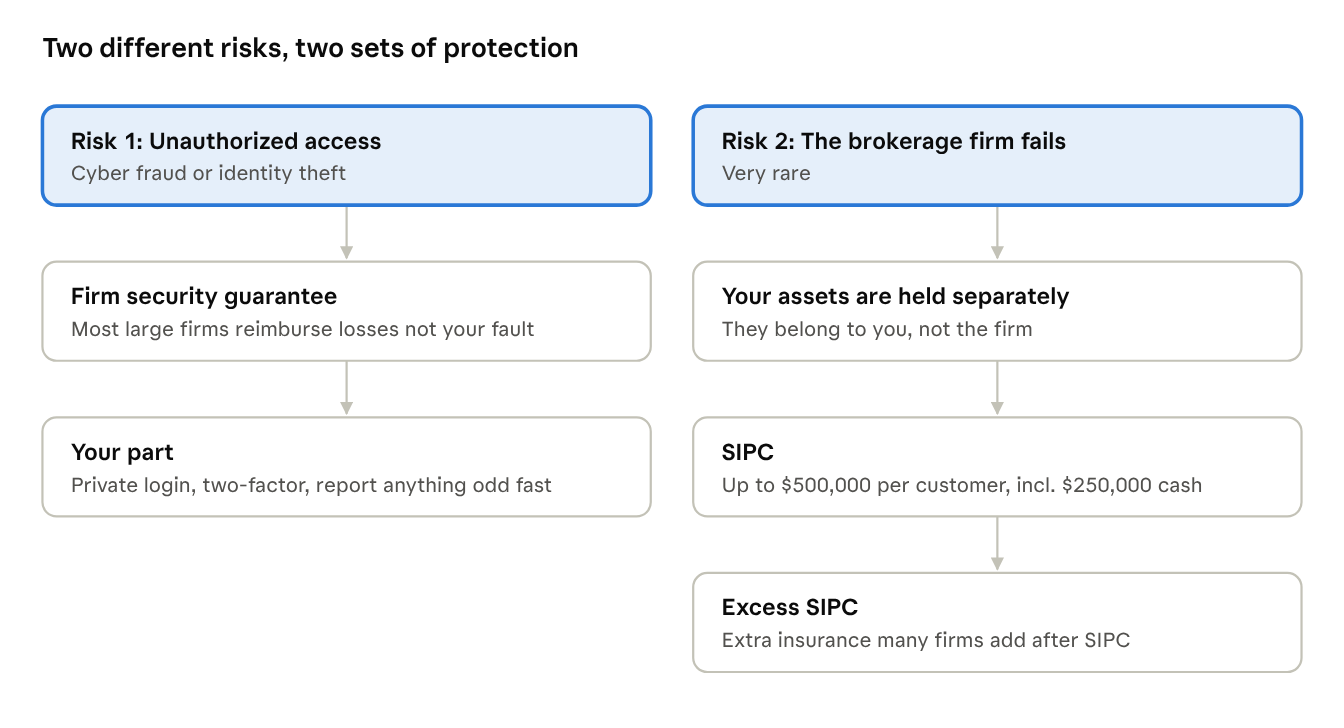
There are two very different risks, and each has its own safety net:

  1. Someone gets into your account without permission. This is cyber fraud or identity theft.
  2. The brokerage firm itself runs into financial trouble. This is rare, but it’s the other worry people have.
Flow chart titled "Two different risks, two sets of protection." Risk 1, unauthorized access (cyber fraud or identity theft), is covered by a firm security guarantee (most large firms reimburse losses that are not your fault) and by your part: a private login, two-factor authentication, and reporting anything odd fast. Risk 2, the brokerage firm fails (very rare), is covered by your assets being held separately (they belong to you, not the firm), by SIPC (up to $500,000 per customer, including $250,000 in cash), and by excess SIPC (extra insurance many firms add after SIPC).

Neither protects against market losses. They keep your assets from going missing, not from going down in value.

If someone gets into your account:

Most large brokerage firms reimburse losses from unauthorized account access, as long as it happened through no fault of your own. We hold most client accounts at Fidelity, and we also use Charles Schwab and Interactive Brokers. Fidelity’s version is its Customer Protection Guarantee.

“No fault of your own” usually means you did your part:

  • Keep your login private. If you share it with anyone, even a family member, their activity counts as authorized by you and isn’t covered.
  • Review statements and alerts regularly and report anything unusual to your firm’s fraud line right away.
  • Keep your phone number and email current so the firm can reach you if something looks wrong.

We’re often asked whether splitting accounts between firms helps, and the answer is: not really. Most large firms offer a similar guarantee, and more firms means more logins to protect. Strong security habits matter more than where your account is held.

If a brokerage firm fails:

  • Your investments are kept separate. By law, firms must hold client assets apart from their own money. If a firm went out of business, your investments would not be used to pay its debts, and in most cases they would simply move to another firm.
  • SIPC is a backstop. If a firm fails and client assets are missing, the Securities Investor Protection Corporation covers up to $500,000 per customer, including up to $250,000 in cash.
  • Excess SIPC adds another layer. Many large firms buy private insurance that applies after SIPC is used up. Fidelity’s coverage, through Lloyd’s of London and other insurers, has a $1 billion total limit across all customers, with no per-customer limit on securities and a $1.9 million per-customer limit on cash awaiting investment.

Your 5-minute security checklist:

☐ Choose a family safe word, and tell everyone who might call you in an emergency

☐ Turn on two-factor authentication, ideally with an authenticator app

☐ Use a unique password for every financial account

☐ Turn on account alerts for logins and withdrawals

☐ Save your advisor’s and custodian’s real phone numbers in your contacts

☐ Consider a free credit freeze at all three credit bureaus

☐ If you’re targeted, report it at ReportFraud.ftc.gov and ic3.gov

Want a hand? Give us a call. Whether you’re a client or comparing firms, we’re happy to help you set up two-factor authentication, talk through a family safe-word plan or double-check anything that feels a little off.

This article is for general informational and educational purposes only. Nothing on it is investment, tax, legal, or accounting advice. Please consult a qualified professional before acting on any information here. Security guarantees and insurance coverage vary by firm and may change. Fidelity and SIPC details are current as of November 2026 and are believed to be reliable as of the date of publication. Baker Ellis Asset Management LLC does not guarantee the accuracy of the article, and it may not be updated. Reading this article does not create an advisory relationship.